St. John’s Fortress – the largest fortress in Šibenik, covering almost 20,000 m² – was built in 1646 on a hill above the old town, on the site of the former Church of St. John the Baptist. Constructed in haste, just before the Ottoman army’s attack, the fortress successfully withstood a new siege the following year. Over the next two decades it was expanded several times and remained in military use until the second half of the 20th century.
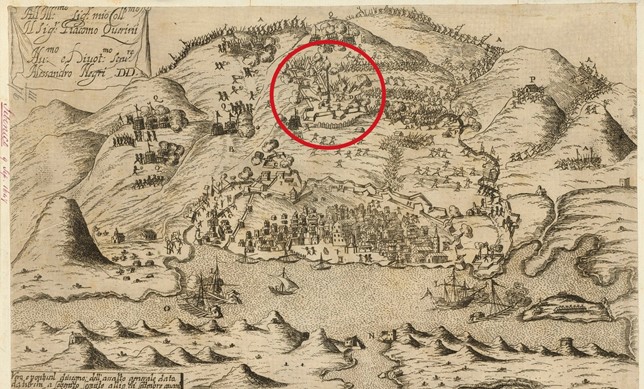
St. John’s Fortress, 1646
After it formally came under civilian use, a children’s playground was built beneath its walls, and a TV transmitter was installed at its highest point a decade later. In practice, however, the fortress was neglected and left to deteriorate – reports stated that the playground was already “in ruins” only eight years after construction. With the surrounding area reforested, the fortress gradually lost visibility, while stone from its outer walls was taken and reused elsewhere. Still, it remained a part of local life for young people in Šibenik, often used as a gathering spot, especially at night.
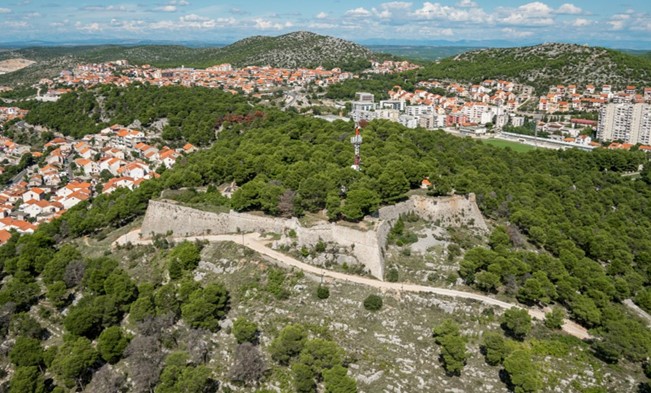
Tvrđava sv. Ivana, 2014. godine
Revitalization and a New Dimension of Heritage
Between 2016 and 2022, the Revitalization of St. John’s Fortress Project, co-financed with EU funds, was carried out. New facilities were added, and large parts of the fortress were archaeologically researched and presented. However, our institution encountered a new challenge: structures from the 20th century within the fortress itself.
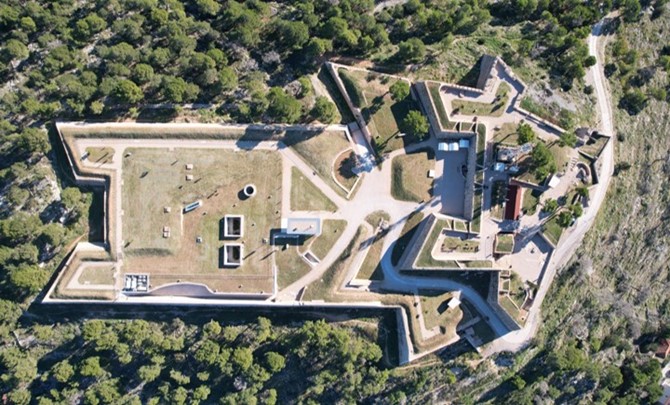
St. John’s Fortress, 2022 (WWII tunnel)
Šibenik held exceptional military and strategic importance in the late 19th and 20th centuries. The Austrians fortified the bay and harbor, followed by new defense positions built by the Kingdom of Yugoslavia, Italians, and Germans during World War II. As a result, nearly every hill in the surrounding area bears traces of bunkers or fortifications.
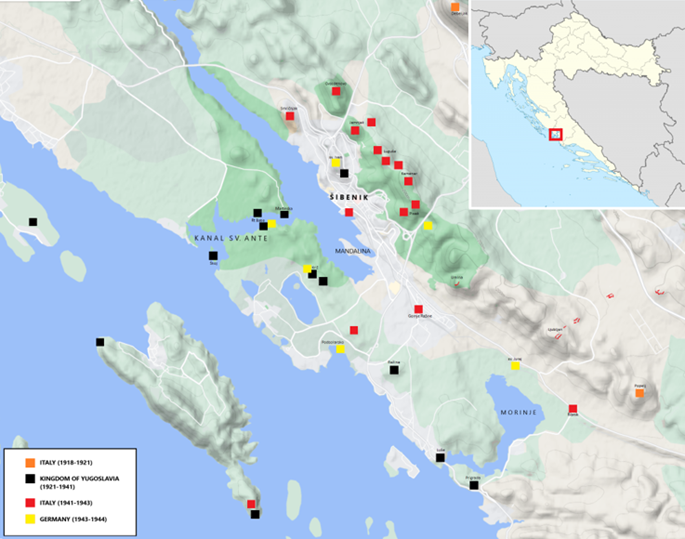
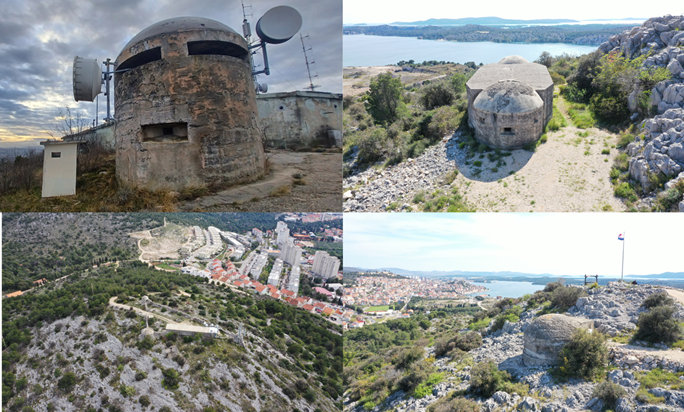
Dissonant heritage in and around Šibenik (bunkers)
Motivated by this fact, and by the recent devastation of some such structures that had passed into private ownership, in 2021 the Department for Research and Heritage Interpretation of Fortress of Culture Šibenik began compiling a catalogue and internal study of Šibenik’s modern fortifications. It was then decided that we would present examples found at St. John’s Fortress.
The first was a Tobruk bunker embedded in the southwest bastion. In 2024, a small exhibition was installed there, focusing on the bunker, the liberation of Šibenik, and several WWII finds – the first time any 20th-century Šibenik fortification received historical interpretation.
The 1944 Tunnel
The second structure from that period is the tunnel, most likely dug in 1944 by the German army. Located at the base of the fortress’s main wall, it runs north–south beneath the fortress. The entrance is irregular, while the southern exit leads to a staircase and a concrete observation bunker. Unlike many other structures of the time, the tunnel is not lined with concrete but carved directly into limestone, giving it a unique appearance and atmosphere.
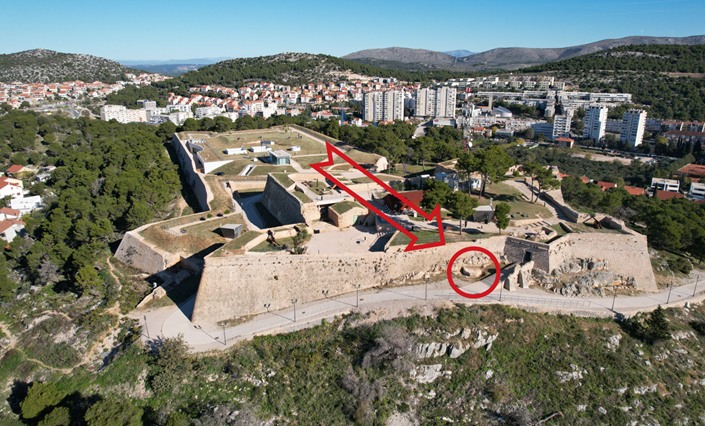
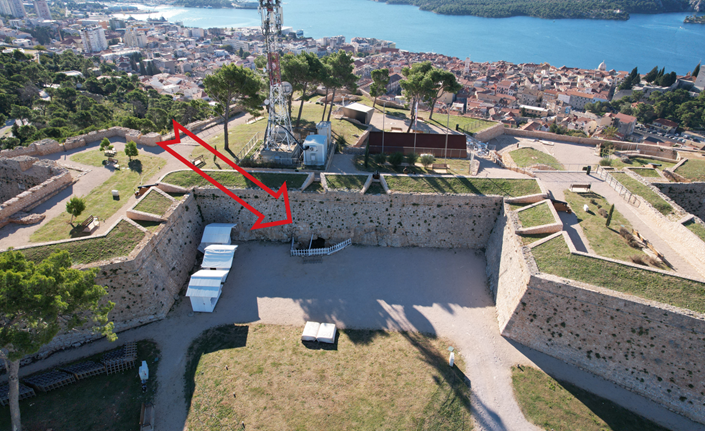
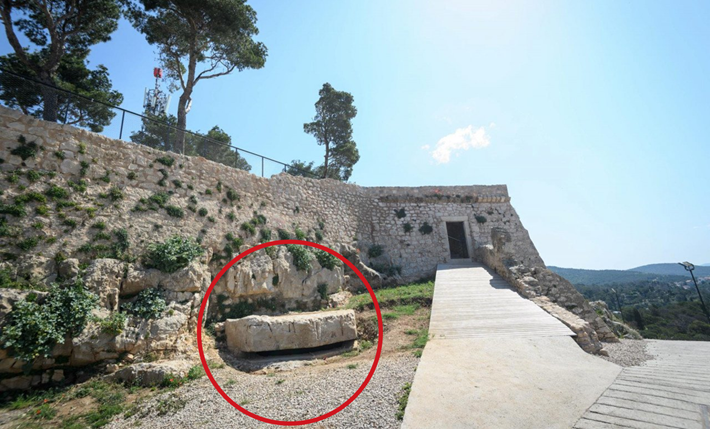
St. John’s Fortress – WWII tunnel (location, entrance, bunker exit)
To prepare the project for adaptation, we first made a floor plan and conducted geodetic surveying – not an easy task underground. Archaeological excavations were then carried out to enable better access. Meanwhile, funding was secured through the GIFTSnet project under the Interreg VI-A IPA Programme Croatia – Bosnia and Herzegovina – Montenegro 2021–2027. The architectural design was completed, and all necessary permits from conservators and authorities were obtained.
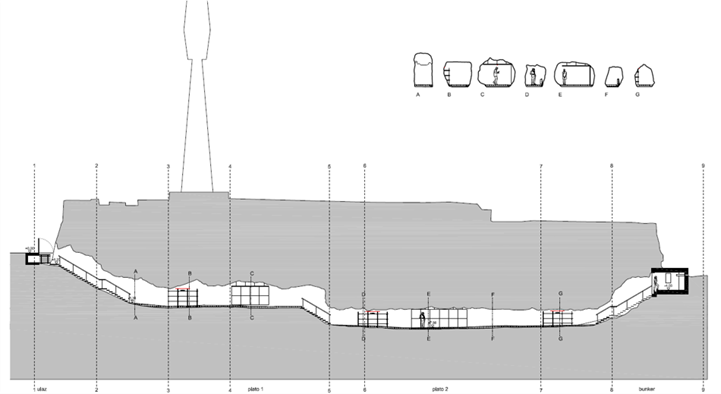
St. John’s Fortress – architectural project
What Will the Tunnel Become?
A natural question arose – what will the tunnel be used for? We did not want to create a traditional historical exhibition, as Šibenik already has institutions and sites covering that period: the Šibenik City Museum, the Museum of Victory and Liberation of Dalmatia in WWII, and the Homeland War Memorial Room.
Our inspiration came from international examples – in France, the Netherlands, Portugal, Czechia, Albania, and other countries – where bunkers have been reinterpreted through artistic interventions. For this reason, our project envisions minimal physical alterations, while the future interpretation of the tunnel will be based on light and sound.
Before summer 2025, a public tender was completed and a contractor selected. The works officially began on 20 September 2025. By the end of the year, we plan to engage one or more artists for a multimedia and audiovisual solution, and the tunnel is expected to be completed by June 2026.
A New Step in Heritage Valorization
We believe that the restoration of this tunnel will be an important step not only in cataloguing and interpretation, but also in raising public awareness of 20th-century fortification heritage in Šibenik and beyond. With this project, our aim is to connect historical heritage with new forms of cultural presentation and open space for contemporary experiences of the past.
The works, carried out by Mar d.o.o. under the supervision of March d.o.o., include structural reinforcement, interior works, installation of lighting, and the introduction of safety measures for future use. The total investment amounts to EUR 292,686.65, funded through the GIFTSnet project.
To recall, the GIFTSnet project (Network for Green and Inclusive Fortified Tourism Solutions) started on 15 September 2024 and will run until 14 March 2027. The lead partner is the Public Cultural Institution Fortress of Culture Šibenik, with partners: City of Banja Luka, Municipality of Bar, City of Karlovac, Public Institution Heritage Museum of Herzegovina Trebinje, and Municipality of Ulcinj. The total value amounts to EUR 2,244,442.80, of which 85% is co-financed under the Interreg IPA Croatia – Bosnia and Herzegovina – Montenegro 2021–2027 programme.